
Inside LaRue Property Tax Records
Think of these records as a chain of linked files, not one page. The PVA roll holds the assessed value, parcel identity, ownership field, and property class. Current collection belongs to the Sheriff. Unpaid bills pass to the County Clerk once the collection window closes. From there, the County Attorney handles certificates. That office also runs the foreclosure path. Attach an office and a date to every field you read.
| Tax field | Meaning in the record | Official source |
|---|---|---|
| Assessed value | Fair-cash value used in the annual assessment process | LaRue County PVA |
| Ownership date | Owner tied to the parcel on January 1 | PVA and Revenue calendar |
| Exemption | Qualified reduction applied for the stated tax year | LaRue County PVA |
| Bill status | Current amount, payment, or delinquency stage | Sheriff, then County Clerk |
| Certificate | Recorded lien created after an unpaid bill transfers | County Clerk and County Attorney |
Kentucky assesses most taxable real estate at 100% of fair cash value, though programs such as agricultural valuation change the math. A tax figure is not a sale appraisal. The deed's consideration, the PVA assessment, and the amount due are three separate facts. The LaRue County property value page explains the difference.
LaRue Assessments at Fair Cash Value
Under the Kentucky Department of Revenue assessment process, the local PVA sets annual values using sales comparison, cost, and income approaches. Inspections are physical at least once every four years. Values are still considered each year. Ordinary taxable real estate carries 100% of fair cash value.
Fair cash value is the estimated price in an open sale. Assessed value is simply the figure on the roll. Special treatment can shift the taxable amount. Agricultural land is one example. Never guess a county ratio to compute a bill.
- Assessed value
- The value placed on the roll by the PVA.
- Fair cash value
- Kentucky's market-value standard.
- Exemption
- A qualified reduction for a stated year.
- Certificate of delinquency
- A recorded lien from an unpaid bill.
LaRue PVA Tax Search Clues
The official qPublic enterprise gateway offers search options by name, address, parcel ID, and alternate ID. Results can display fields such as Parcel, Alternate ID, Address, Ownership, City, Area, State, ASV, Ref Num, and STR. Treat these as a search plan. The LaRue instance may show fewer fields.
| Search key | Best use | Check after matching |
|---|---|---|
| Address | Known site | Parcel and road variant |
| Owner | Parcels on the roll | Date and spelling |
| Parcel ID | Tax, deed, and map match | Punctuation and suffix |
| Alternate ID | Older office locator | Confirm with PVA |
The PVA office sits at 209 West High Street, Hodgenville, and answers at (270) 358-4202. Write down the parcel number and the date you checked. If the portal is down, call the office. An outage never means no assessment exists.
LaRue Property Tax Calendar
The Kentucky property tax calendar fixes January 1 as the assessment date. January 1 is also the ownership date for billing. Listing runs January 1 through March 1. The roll opens for public viewing for thirteen days starting the first Monday in May. It runs six days a week including Saturday.
A transfer later in the year may send the bill to a new owner. The new owner receives it in care of the old one. The January 1 rule still explains the billed name. A private contract can divide the cost between buyers and sellers. The annual record still stands. Always compare deed dates with assessment dates.
Note: LaRue County's 2025 and 2026 notices show how this statewide schedule is applied locally.
LaRue Homestead Record for 2026
The official 2026 LaRue notice sets the homestead exemption at $49,100 for that tax year. That figure belongs to 2026 alone. Kentucky Revenue requires an eligible owner to file with the PVA. The deadline is December 31 of the eligible year. Do not carry the amount into another year without a current notice.
For a qualified applicant, the exemption lowers the taxable assessment. It touches nothing else. The deed, the parcel line, and the sale price stay the same. Note the year, the exemption label, the amount, and your source.
Trace a LaRue Tax Bill
A careful bill lookup follows the account across both custodians, current and delinquent. The County Attorney directs taxpayers to the Sheriff's tax site. Confirm the link is secure before entering anything there. The office routes still work when the site does not.
- Get the parcel number and assessment year from the PVA. Confirm the owner date and exemptions.
- Check the Sheriff's current bill route and note amount and payment state. Call if the security warning persists.
- After an unpaid bill transfers, ask the Clerk for its Certificate of Delinquency, assignment, or release.
- Use County Attorney and court files to trace purchase, foreclosure, judgment, and final conveyance.
The Clerk operates from 209 West High Street, Suite 3, Hodgenville, weekdays from 8:00 AM to 4:30 PM. Bring the year, the parcel, the names, and the address. Ask first whether a third party bought the certificate before you try to pay.
LaRue Delinquency Is a Timeline
Per the County Attorney's delinquent-tax explanation, bills go out around October. They fall due December 31. The Sheriff holds them through April 15. An unpaid bill then transfers to the Clerk. It becomes a Certificate of Delinquency under KRS 134.122. Interest runs 12% per year under KRS 134.125, with two notices issued.
After the statutory period, a third party can buy the certificate. That purchase is not a deed. Payment, assignment, foreclosure, judgment, confirmation, and a commissioner or sheriff deed are each separate events.
Tax-sale myth. A notice or certificate purchaser does not prove that the purchaser owns the LaRue County parcel.
View the official delinquent-tax source shown below.
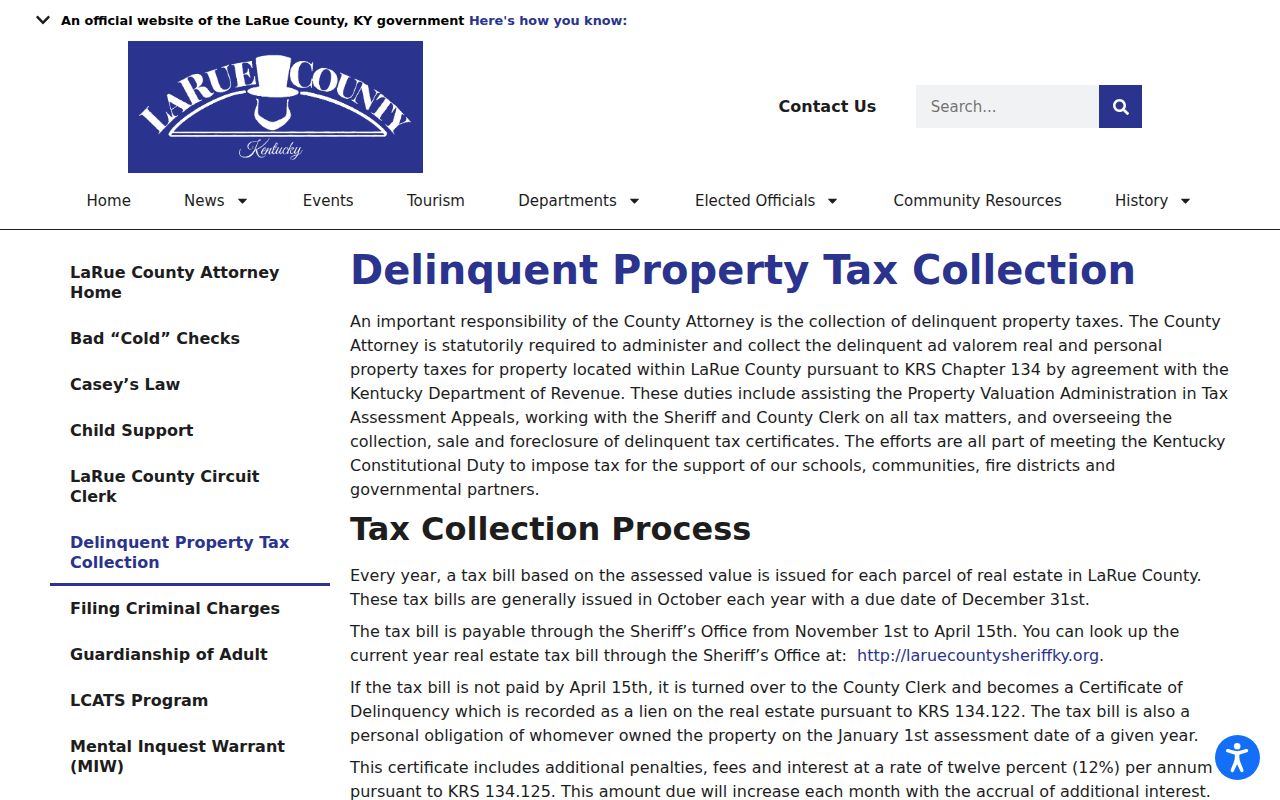
The sequence separates the lien stage from a completed transfer.
LaRue Tax Foreclosure Records
When a tax lien goes all the way to foreclosure, the trail leaves the tax roll. It then enters the courtroom. The complaint, the judgment, the order of sale, the commissioner report, and the final confirmation all live with the Circuit Court Clerk. The Kentucky Court of Justice LaRue page is the starting point. It lists the annex at 209 West High Street and the number (270) 358-3421. One caution is worth heeding: retention schedules mean some files sit elsewhere. Some no longer exist at all.
Tie every name in the case back to a parcel number and legal description. That is how you know the lawsuit matches the land. Once it does, go back to the Clerk for the deed or release. That document closed the matter. A lien, a lawsuit, and a transfer of ownership are three distinct records.
Contest a LaRue Property Assessment
Start with the PVA. Bring proof when you meet, because the appeal clock in Kentucky is short. The roll notice lists the local dates that matter. Good evidence includes physical traits of the parcel, insurance information, construction cost, and comparable sale listings. Tie each item to the valuation date.
Remember that an appeal challenges assessed value only. It does not touch the tax rate or the title. A supplemental bill can follow when the first bill was issued before the appeal ended. So check the result and the later bill.
Appeal window. Confer with the PVA first, keep proof, and use the current LaRue roll notice because exact dates change by year.
LaRue Tax Records Offline
Online access is only one channel. For assessment facts, call or visit the PVA. Have the parcel number, address, owner names, and tax year ready. For the current bill, use the Sheriff route after confirming the connection is secure. Once an unpaid bill transfers, the County Clerk keeps the certificate record. The County Attorney handles the collection and foreclosure process it describes. A written Kentucky Open Records Act request can seek nonexempt administrative records, notices, maps, and correspondence. Send it to the office that holds them.
Keep the request narrow. Name the parcel, the year, the record type, and the date range. Ask for the current assessment record, bill status, certificate, assignment, release, notices, or court file. List each as a separate item. The Attorney General's guide allows delivery by hand, mail, fax, or email. It also sets a five-business-day response rule. That rule does not put every document online, and it does not override a lawful exemption.
A scanned item that is hard to read may warrant a certified copy from the Clerk. If a portal returns no result, note the cause. The search may have failed, the system was down, the parcel number changed, or the item lives only at the counter. Those distinctions keep a negative search from becoming a false claim about the LaRue County tax record.
Log Every LaRue Tax Source
A useful LaRue County property tax record packet labels every fact with a date. It also names the office behind each fact. Save the parcel number exactly, punctuation and suffix included. Record the assessment year, the January 1 owner, assessed value, exemption, bill year, and payment status. Also note the date each portal or office was checked. If the bill is delinquent, add the certificate date, purchaser or assignment, and release. Include the court number and the deed reference.
This log makes a mismatch understandable. A deed recorded after January 1 can be newer than the tax owner of record. An exemption may cover just one year. A third-party certificate may later be paid or released. A court case may close without the ownership change its first notice implied. Use the latest official record for each stage rather than forcing all dates into one answer. Preserve copies of annual notices, because deadlines and exemption amounts can change.